How to Make a Good Photo Dump That Feels Real and Gets Saved
Anyone can post nine photos. The difference between a dump people scroll past and one they save comes down to variety, sequencing and one deliberately imperfect frame.

Posting a photo dump is easy. Posting a *good* one is a craft, and the craft is mostly about restraint. Here is what separates the two.
Variety is the whole game
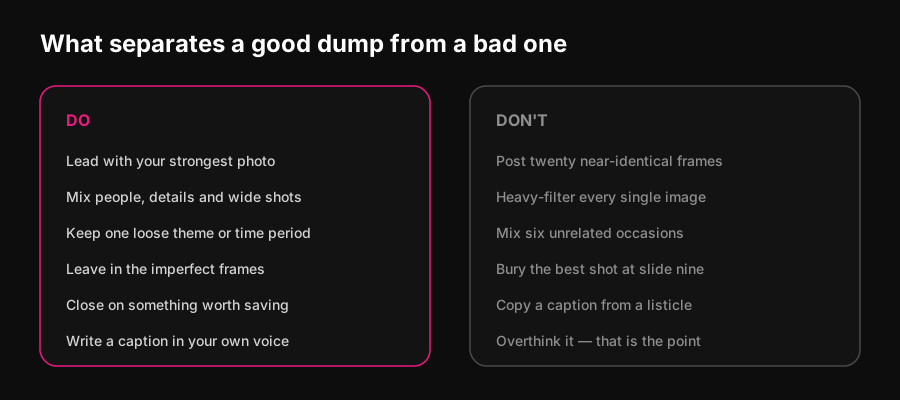
The single most common failure is repetition. Six photos of the same brunch table, shot from slightly different angles, is not a dump — it is indecision made public.
A good dump moves between registers:
- **A face.** Someone you were with, ideally caught rather than posed.
- **A detail.** Hands, a glass, a sticker, peeling paint.
- **A wide shot.** Establishes where you actually were.
- **Something edible.** Not compulsory, but it is basically compulsory.
- **Something strange.** A sign, a dog, a reflection, a screenshot.
If two consecutive slides could be swapped without anyone noticing, one of them should go.
Leave one thing wrong on purpose
This is counterintuitive and it is the thing that makes a dump read as genuine. One frame that is slightly blurry, badly lit or accidentally taken does more for the post than another competent photo would.
The reason is contrast. Perfect images next to each other read as a campaign. One flawed frame in the middle recodes the whole set as something that happened rather than something produced.
The imperfect photo is not filler. It is the load-bearing element.
Sequence for the two slides that matter
Only two positions are guaranteed attention: the first and the last.
- 1**Slide one** is your cover, your thumbnail, and the only image most people see. It has to stop a scroll on its own.
- 2**The last slide** is what determines whether the post gets saved or screenshotted. Make it the funny one, the tender one, or the punchline.
Everything between them is texture. Vary it, and do not put your second-best photo at position nine where nobody will reach it.
Keep the editing inconsistent
Applying one filter to all nine images is the fastest way to make a dump look manufactured. Some frames edited, some untouched, is closer to how a real camera roll looks — because that is how a real camera roll looks.
Give it one thread
A dump needs something holding it together, but the thread can be loose:
| Thread | Example |
|---|---|
| Time | One weekend, one month, "lately" |
| Place | A trip, a city, a single venue |
| Mood | Slow days, a good week, chaos |
| Occasion | A birthday, a move, a season ending |
What does not work is six unrelated occasions in one post. There is nothing to follow.
The part worth automating
Everything above assumes you have already found the nine photos, and finding them is the tedious bit. Two hundred frames from a weekend, most of them near-duplicates, at eleven at night.
PhotoDump does that pass for you: it groups by time and place, cuts duplicates and near-misses, and returns a shortlist already sequenced with a strong opener. You still choose — it just removes the scrolling. Everything runs on your device.
Common questions
Variety between slides, a strong first image, a memorable last one, and at least one deliberately imperfect frame. Repetition is the main thing that makes a dump fall flat.
No. Consistent heavy editing makes it look like a campaign. Mixed or minimal editing reads as authentic.
Your strongest image. It is the cover and the thumbnail, and for most viewers it is the only slide they will see.
Cut harder than feels comfortable, vary the subject and crop between every slide, and end on something worth saving.